How Many Job Applications Does It Actually Take to Get an Interview in India? (2026 Data)
If you've applied to 40 jobs this month and heard back from maybe one, it's natural to assume your resume is broken, your experience isn't good enough, or you're doing the search wrong somehow.
You're probably not. You're experiencing the average.
The numbers, plainly
Applications per open role in India have more than doubled since early 2022, according to LinkedIn's own January 2026 research. For competitive functions — product management, marketing, software engineering — a single posting can now pull in 500 to 1,000 applicants.
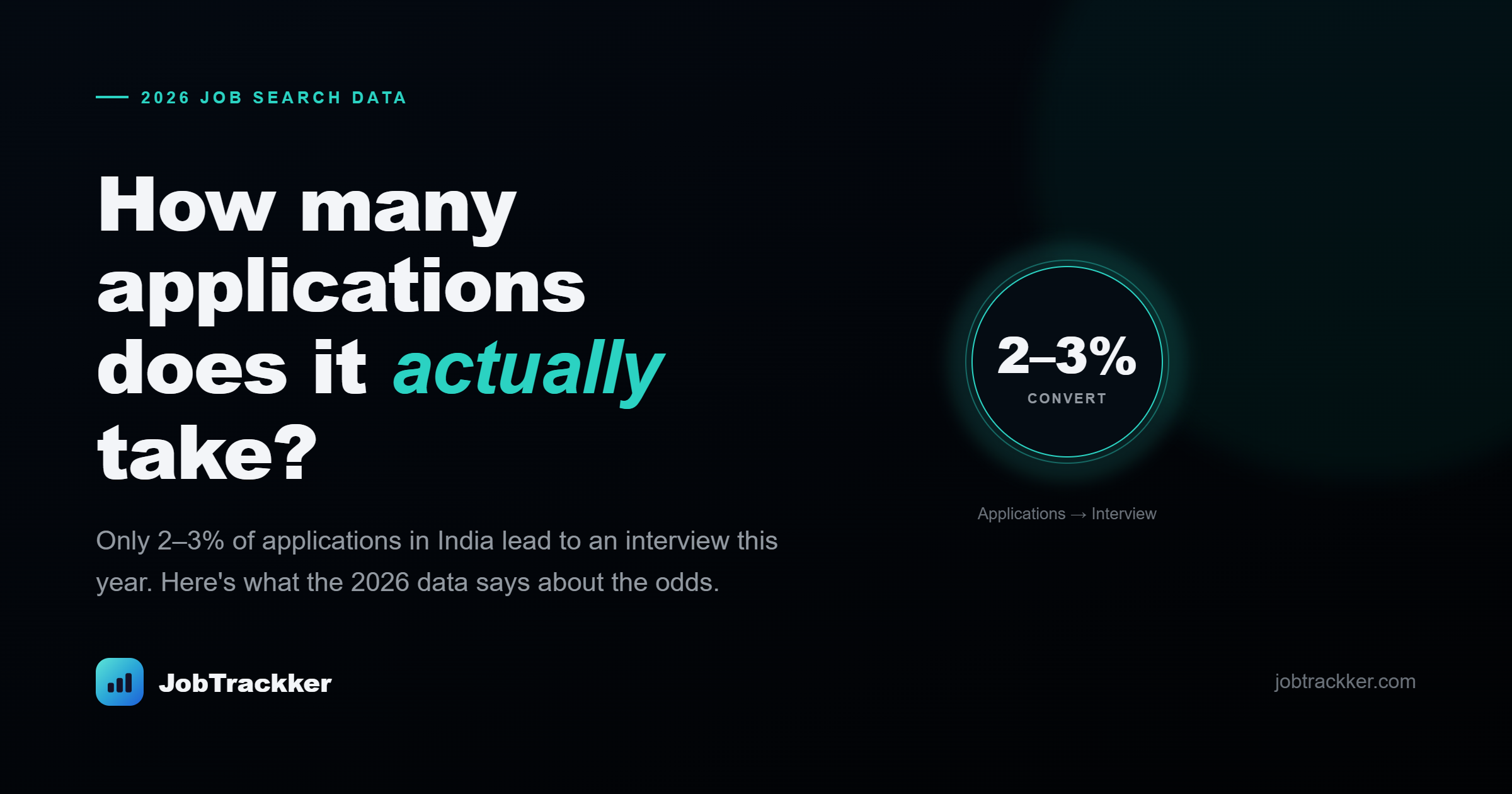
Against that volume, only 2 to 3% of applications in India lead to an interview this year. Send 100 applications, and hearing back from two or three of them isn't a bad outcome — it's roughly what the funnel predicts.
Globally, the pattern holds: recruiting data from tens of millions of applications puts the applicant-to-interview conversion rate at around 3%, with an average of roughly 42 applications submitted per interview earned. The exact numbers move depending on which report you read, but the shape of the curve is consistent everywhere it's been measured — a large majority of applications end in silence, and that silence is structural, not personal.
Why the funnel is this narrow
A big part of the answer is upstream of any human ever reading your resume. Close to 90% of resumes submitted in India fail applicant tracking system (ATS) screening due to formatting or keyword mismatches — not because the candidate lacked the qualifications for the role. The system filters on parsing, not merit, and most resumes aren't built with that filter in mind.
The other part is simply volume. When one posting draws 500+ applicants, even a well-qualified, well-formatted resume is competing against hundreds of others chasing the same handful of interview slots. No amount of individual polish changes the denominator.
What this means for how you search
None of this is a reason to stop applying — it's a reason to stop treating every silence as a verdict on you personally, and a reason to be deliberate about where your effort goes:
- Fix the ATS layer first. Formatting and keyword alignment are the most common reasons for getting filtered out before a human ever sees the application — and the most fixable.
- Track what you send. At this volume, the practical problem stops being "should I apply" and starts being "did I already apply here, what stage is it at, and do I need to follow up" — spreadsheets get unwieldy fast once you're past 20-30 active applications.
- Weight quality over raw volume. Tailored, targeted applications consistently outperform generic mass-applying in every dataset on this topic — the math favours fewer, better-matched applications over blasting the same resume everywhere.
- Expect the silence, don't personalise it. A non-response at this conversion rate is the median outcome, not a signal that something is uniquely wrong with your candidacy.
The honest takeaway
If you're in the middle of a search right now and it feels unusually hard, the data backs up that feeling — it is harder than it used to be, for structural reasons that have very little to do with any individual applicant. The candidates who come out ahead aren't the ones sending the most applications. They're the ones who fix what's fixable (resume formatting, targeting, follow-up discipline) and stop bleeding energy on what isn't (taking every silence personally).
This is also exactly the gap JobTrackker was built to close. At a 2-3% conversion rate, staying organised stops being optional — once you're past 20-30 live applications, keeping track of what stage each one is at, when to follow up, and which resume version you sent where becomes a job in itself on top of the job search. JobTrackker's match scoring also helps on the targeting side, flagging how well a role actually fits before you spend an application on it — so more of your limited attempts go toward roles worth the shot, instead of getting lost in the same 500-applicant pile as everyone else.